
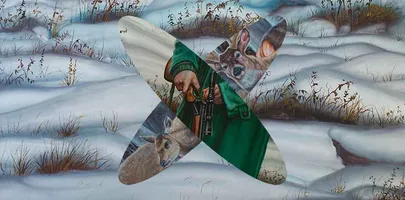
Michal Nagypál - Temporary agreement between reality and illusion
Opening: 9 October 2025, 18.00
Curator.
Duration of the exhibition: 10. 10. 2025 - 11. 1. 2026
Hall Q, Hlavná 27, Košice
The work of Michal Nagypál, a contemporary Slovak painter, moves on the thin border between reality and fiction, between concrete observation of the world and imaginative transformation, which gives it a new meaning. The artist's programmatic gesture can best be captured by the phrase 'Temporary agreement between reality and illusion' - it is a fundamental idea that permeates his painting and digital experiments. Nagypál does not assume reality as an immutable fact, but rather as a material that can be distorted, mirrored, exaggerated or poetically rewritten. What emerges is a distinctive synthesis of magical realism, surrealist strategies and contemporary reflections on the post-digital image.
Nagypál is faithful to the traditional painting medium of oil on canvas, which he combines with delicate modelling of shapes. In his case, the material grasp of painting is combined with an attention to detail: whether it is the subtle transitional tones in the depiction of the sky, or the texture of animal fur or the texture of a plant surface. In terms of technology, or the preparation of the pre-image, Nagypál works with digital tools that allow him to create mirror compositions of images, distorting them and shifting them into positions of visual paradoxes. On the other hand, the unmanipulated photographic vision is a tool for further cycles of paintings that give an outright hyperrealistic impression. The combination of the analogue and the digital, one could say, is at the core of the creative method - painting is not an isolated medium, but part of a broader visual laboratory, from which sculptural objects or more intimate graphic letters have also emerged. The 'Photoshop-like' principle of manipulating an image - deforming it, mirroring it, stretching it, overexposing it, etc., is in Nagypal's case a certain way of sketching, of creating a template for the resulting composition.
Nagypál's iconography concentrates around the themes of nature, its beauty and fragility at the same time. Trees, animals, clouds or water masses appear in positions that look familiar, but at the same time they are as if transported into a dreamlike space. Nature here is not idyllic; it carries a latent threat - storms, floods, landslides and other apocalyptic scenarios. The Calamities series thematizes natural disasters that are part of our ecological consciousness. The motif of death and extinction is intertwined with a mystical element - animals and plants take on a symbolic value, sometimes downright animistic. Trees seem to have eyes, animals act as messengers of another world. This is a reference to the surrealist heritage, where the living and the inanimate, the real and the fantasy cease to have firm boundaries.
Nagypál reflects the wider international context, where the theme of ecology, the climate crisis and the post-humanist perception of nature is increasingly coming to the fore. The large-scale series of ten paintings entitled The Hunt, created between 2024 and 2025, illustrates such an example, illustrating the artist's interest in environmental themes from an opposing, as it were empirical perspective, in the phenomenon of hunting. Whichever way we look at this field, the themes of the protection of life and the inevitability of bodily demise are intertwined here. Nagypál styles himself in the role of a hunter and the hunted, but at the same time positions himself as a cultural anthropologist. He offers us, through veristically captured situations of archaic hunting themes, several stories whose starting points go back to the minds of prehistoric hunters. The main theme of this series is precisely the inclination towards the theory of hunting the soul of the animal, while the author opens up other levels of meaning in his paintings - biological, spiritual, ethical or religious. Inspirational planes can be seen, for example, in the work of the Flemish painter Frans Snyders (1579 - 1657), or the turn-of-the-century Finnish painter Akseli Gallen-Kalleau (1865 - 1931).
Ecological themes, fauna and flora are Nagypal's particular mystique - visually well-read, but lazing between reality and mirage in terms of meaning. They are symbols of transformation, mirrors of human existence. Fauna and flora take on a sacred dimension that is associated with archetypal images. Natural disasters are metaphors of human destiny, its fragility and the inevitability of extinction. Mysticism is intertwined with science - as if the painter was searching for a new visual language to interpret the planet and society in the era of the Anthropocene.
A fundamental component of Nagypál's work is the inclination to try to reinterpret familiar images from art history. In the Crossroads series, Nagypál's painterly expression is stylized directly into the position of a copyist, but this is not his intention, nor ultimately the formal result. The digital distortions of Renaissance paintings are evidence of his conscious work with visual memory. For Nagypal, the old masters of the Transalpine Renaissance, or representatives of Dutch and Flemish painting of the 15th-16th centuries, are the material that he transforms by mirroring and symmetrizing the original images. New wholes are thus created that evoke the famous Rorschach tests. This opens up the space for a psychological game - each viewer sees something different in these structures, projecting their own subconscious into them. A kind of strange form of 'abstract' realism emerges, which is thus an oxymoron, but places us in realities similar to those of intoxication in any sense of the word.
Michal Nagypál (1992) studied at the School of Applied Arts in Košice, majoring in Promotional Art in 2008-2012. After his secondary school studies, he joined Martin Mainer's painting studio at the Academy of Fine Arts in Prague (2012 - 2016) and in 2017 - 2018 he completed an internship in Lukáš Rittstein's sculpture studio. He currently lives and works in Gönc, Hungary.