
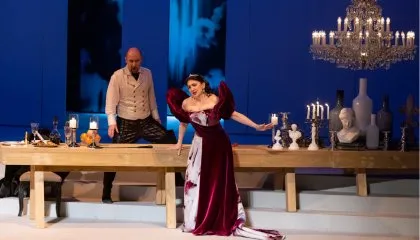
Giacomo Puccini: TOSCA
The story of the famous and fragile singer Tosca, the passionate painter Cavaradossi and the sadistic police chief Scarpio, with Giacomo Puccini's haunting melodies that have become immortal.
When Giacomo Puccini first saw Victorien Sardou's play La Tosca, starring the world-famous French actress Sarah Bernhardt, in 1889, he immediately recognised the subject as suitable for an operatic treatment and asked his publisher Ricordi to acquire the rights from the author of the draft. However, it was another long 10 years before the score was completed and Tosca could be performed in Rome on 14 January 1900.
Tosca is a story of love, jealousy and passion, as well as torture and murder. Critics of the time unanimously blamed this criminal political theme about the abuse of power, set in Rome during the Napoleonic Wars of 1800, for excessive naturalism, the pursuit of sensation and music that is painted in too crude colours.However, after its performance at La Scala in Milan, just two months after its Roman premiere, Tosca embarked on its triumphal pilgrimage through the stages of the world's opera houses and has never disappeared from them. To this day, we are still drawn to the story of the famous and fragile singer Tosca, the passionate painter Cavaradossi and the sadistic police chief Scarpia, as well as to Giacomo Puccini's haunting melodies, which have become immortal.
The director of the new production is Anton Korenči, the costumes were designed by Boris Hanečka and the scenic design by Lucia Tallová. The main element of the set is a monumental image of a dramatic black sky from the series 'Clouds', which Lucia Tallová created especially for the opera Tosca and the State Theatre in Košice.
Location.