
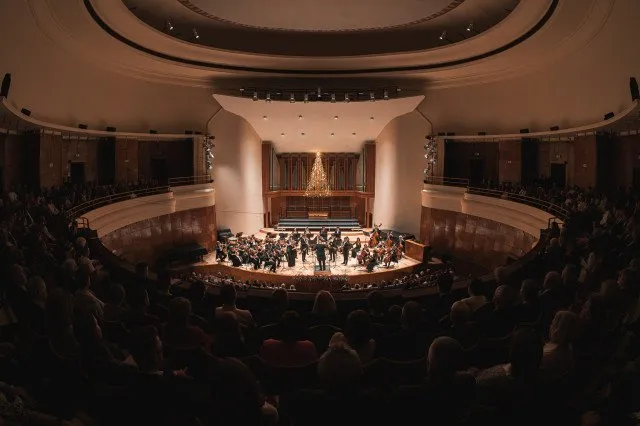
BACH AND THE SOUNDS OF CHRISTMAS
Košice State Philharmonic
Zbyněk MÜLLER, conductor and oboe
Maroš POTOKÁR, violin
Barbora LENÁRTOVÁ, violin
Pro Musica – Magnólia Children’s Choir
Viera DŽOGANOVÁ, choir director
Collegium Technicum
Iryna DEMIANYSHYNA, choir director
Michal ONUFER, bass
Program:
Johann Sebastian Bach: Concerto for Two Violins and Orchestra in D minor, BWV 1043 15'
Johann Sebastian Bach: Concerto for Oboe and Orchestra in D minor, BWV 1059 14'
— intermission —
Norbert Bodnár: Christmas Mass in F for solo bass, children’s choir, and orchestra 24'
Arthur Honegger: Christmas Cantata 25'
The Concerto for Two Violins in D minor, BWV 1043, ranks among the absolute highlights of Bach’s instrumental oeuvre and is one of the most popular works of the late Baroque period. The work represents a perfect synthesis of the Italian style of the time—particularly the influence of Antonio Vivaldi—and Bach’s own deeply refined German counterpoint. Unlike traditional concertos, where a single soloist competes with the orchestra, here Bach brings instruments of equal standing to the forefront. They constantly interact, blend together, imitate one another, and engage in a fascinating musical dialogue. The work opens with an energetic, fugato-like theme in the orchestra, which is immediately taken up by both soloists. The music is full of rhythmic energy and a strict polyphonic structure, in which both performers pass off virtuosic passages at breathtaking speed. In the second movement, a rhythmically calm accompaniment in the Siciliana style creates space for a beautiful cantilena. The final movement is characterized by a brilliant imitation of both solo voices, with dynamic themes alternating at a thrilling tempo.
Of Bach’s original Concerto in D minor, BWV 1059, for oboe , only a fragment of the first nine measures, recorded in his manuscript, has survived. The rest of the work is known thanks to a later reworking of its musical material into the form of the Concerto in D minor for Harpsichord and Orchestra. Modern reconstructions of the oboe concerto have been created based on these sources. The composition is likely connected to Bach’s time in Köthen. The reconstruction of the concerto follows the three-movement model of Allegro–Adagio–Presto. The first movement is built on a distinctive ritornello principle, with orchestral restatements of the basic material alternating with solo episodes in which the oboe is given space for both melodic and figurative invention. The Adagio offers the greatest expressive contrast. A long cantilena of the solo instrument unfolds over a calm harmonic foundation, its character closely resembling vocal melody. The concluding Presto once again presents music full of motoric movement and contrapuntal activity, with Bach building tension primarily through fierce rhythmic energy and brilliant layering of imitations.
Norbert Bodnár’s Christmas Mass in F for solo bass, children’s choir, and orchestra was created by expanding and revising the 1996 “Little Christmas Mass” for children’s choir and orchestra. Compared to the original version, a solo bass part (quasi-shepherd figure) and three new movements have been added. In addition to the text of the Mass Ordinary, verses from Slovak folk poetry are set to music in this impressive composition. The composer says of it: “In terms of melody and harmony, as well as thanks to the combination with the children’s choir, my work is very accessible and appealing. In the Mass, which consists of five main sections, I tried to incorporate everything associated with Christmas and the Mass in general: a solo organ cadenza, occasional a cappella choir, bells, folk instruments—the ozembuch, fujara, bagpipes, and an overall joyful atmosphere. In short, I tried to delight not only the listeners but also myself with this composition.”
Une Cantate de Noël ( A Christmas Cantata) is one of the last and most significant works by the Swiss composer Arthur Honegger. He composed it in 1952–1953 for the Basel Chamber Choir and its founder, Paul Sacher. It is an extensive vocal-instrumental composition for baritone solo, mixed choir, children’s choir, organ, and orchestra. Honegger conceived the Christmas story as a fascinating interweaving of compositional elements and structured it from various, contrasting sections. The introduction is marked by a dark, tense sound. The organ introduces slow music, from which the choral “De profundis,” based on Psalm 130, gradually emerges. The musical progression builds toward a dramatic climax and the subsequent biblical message of Christ’s birth. The centerpiece of the cantata is the *Quodlibet des Noëls*. In it, Honegger interweaves traditional French and German Christmas carols with the Latin text of the *Gloria*. The layering and contrapuntal interweaving of the songs create a distinctive and colorful musical tapestry in which diverse traditions converge in a magnificent sonic tapestry.