
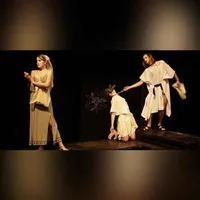
Bez StropU Studio TRE PONTI
Group Name:
Ateliér Bez StropU
Production Title: TRE PONTI
Category: Youth Theater (ages 14 and up)
Year of Premiere: 2025
Creative Team
Author: Daniel Pikalík
Dramatization, Adaptation: Matúš Lubinský
Director: Daniel Pikalík
Set Design and Costumes: School of Applied Arts in Košice, Jakobyho 15
Choreography: Viktória Hámorová
Consultant: Jana Zordan
Music direction: Olha Kyryliuk
Music Used (Artist and Song Title):
Iliad in Greek: Patroclus’ Death – arum_natzorkhang, Swing Time – MusicByPedro, Tammurriata Nera –
Nuova Compagnia Di Canto Popolare, Whispers Of Ancient Delphi - Public Domain AI-generated
Other contributors:
Sergej Sinicyn, Janka Duchoňová, Ľudmila Benková, Timea Oberlová
People and cast:
Viktória Hámorová, Jakub Kubalík, Tamara Maurerová, David Gunár, Martin Piško, Richard Topor,
Ronald Billy, Daniil Popov
Smoking or open flames on stage:
Yes
Other:
The production uses elements of luminescent lighting.
About the troupe/characteristics of the collective:
Ateliér Bez StropU is a creative collective based on openness in both form and content. It brings together members and
collaborators through a shared vision for their work and an experimental approach to theater.
It works in alternative, street, and site-specific spaces, but also moves just as naturally into
traditional theater settings. It embraces the principles of multimedia and visually layered theater.
Thematically, the company focuses on fundamental social issues and leans toward original and absurd poetics.
It supports the creation of new texts and artists who approach the world without prejudice or normative
restrictions. It does not limit itself to any specific genre; it uses the tragicomic principle as a means of sensitively uncovering
social stereotypes.
A Word About the Production:
TRE PONTI A Comedy of Two Millennia The story traces the journey of comedy as a theatrical genre across
three eras. The ancient philosopher Neavius guides us through the introduction. He draws us into the story of the characters’ fates
through an amulet, which is a symbolic and key element of the production. The main
protagonists are also two lovers who are fatefully tormented by unfulfilled love, and this archetype
appears in each of the individual acts, which Neavius mysteriously unravels. Against the backdrop of these events,
a borrowed, temporary immortality takes shape. The unsuspecting characters are transported through time. They find themselves in
Renaissance Italy, in the era of street comedy, led by none other than the ringmaster Neavius. He
is the only one who can consciously grasp the absurdity and bitterness of this comedy. The lovers, however, long to escape from
the archetypes of these ill-fated times and seek a path to the New World. September 1, 1939. The Nazis have invaded Poland, and
the action shifts to Chicago, where the descendants of Rome migrated en masse, and now a handful of them find themselves in the bar
of local boss Papp. Yet the amulet, which travels through all the acts, finds the lovers and fulfills the fate of suffering
spanning two millennia. The story ends with a tragic epilogue for Neavia, now nothing more than a vagabond wallowing in the rubbish heap
of history.
Suitable for ages 14 and up
Technical Requirements
Performance length (min.): 50
Intermission: none