
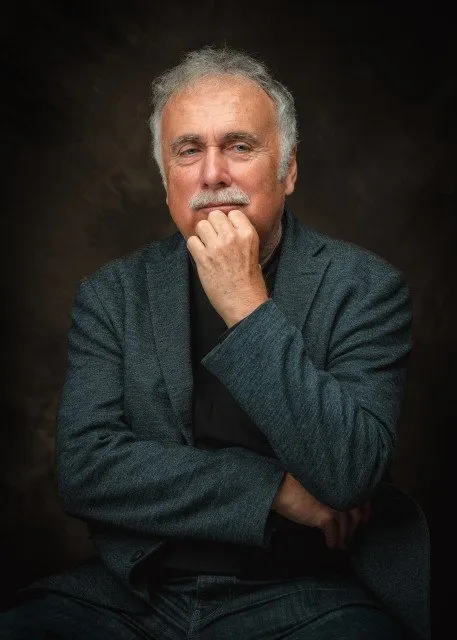
HAPPY BIRTHDAY, NORBI!
Košice State Philharmonic
Miki SKUTA, piano
Ondrej OLOS, conductor
Program:
Norbert Bodnár: Aeternus – world premiere 15'
Norbert Bodnár: Concerto for Piano and Orchestra No. 1 22'
— intermission —
Francis Poulenc: Sinfonietta FP 141 28'
This concert commemorates the Day of the Struggle for Freedom and Democracy.
Composer Norbert Bodnár wrote the following about his compositions:“Aeternus translates as ‘eternal, lasting.’ The piece was commissioned by the ŠFK to mark my 70th birthday. The title is evocative, but the ‘eternity’ referred to pertains to eternal harmony, melody, and established forms—that is, something that the evolution of music over the centuries has brought about (and which I consider the best that the Baroque, Classicism, and Romanticism have bestowed upon us). That is why *Aeternus* is a work of neo-revival, as is my custom—I combine styles; there is also a bit of jazz, counterpoint, and experiments that have their origins in the 20th century (aleatoric music, clusters). The sonata form serves as a sort of framework that encompasses my dialogue with Beethoven and Mozart, but also with Bartók, Bernstein, and Copland. I tried to write a work that would not deter the listener on the path toward the infinite harmony of art and existence. It may be a lot to ask, but what can you do now that the evening has begun… *Aeternus* will receive its world premiere.
Piano Concerto No. 1 is a work two years older than Aeternus; it will be performed for the first time in Košice. I’ve always tried to explore (experiment with) all possible forms and genres, and sometime in 2023 I realized that a concerto for piano and orchestra was missing from my repertoire. So I decided to write one. I’m a fan of all things “classical”—which is why the Concerto has three movements (an amusing fact is the order in which I wrote the movements—first the second movement, then the third, and finally the first). The inspiration comes from B. Bartók’s Piano Concerto No. 3 —its second movement has just the right mood, which I tried to evoke. The other “friends” (the third and first movements) arrived later. My Concerto also features plenty of melody, harmony, and a blend of styles (sometimes referred to as eclecticism)—I cannot imagine music without these essential elements. At the same time, I tried to ensure that the soloist had something to “show off,” so that it wouldn’t be a cacophony or minimalist music. I hope this intention was successful.”
Francis Poulenc is one of the most prominent figures in 20th-century French music. His Sinfonietta was composed between 1947 and 1948. The work is characterized by the lightness, dance-like quality, and elegance typical of Poulenc’s music. In his work with the orchestra, the composer granted individual instrumental sections considerable tonal and rhythmic independence. The four-movement composition is full of expressive moments and unexpected twists. The opening Allegro con fuoco brings energy, sharpness, and a typically Poulenc-esque sense of humor, while the second movement, Molto vivace, comes across as an elegant and, at times, almost grotesque scherzo. The Andante cantabile reveals a more lyrical side of the composer’s personality, and in the final Très vite et très gai, the music once again bursts into a dazzling rhythmic whirlwind. In this work, Poulenc deliberately employs sudden shifts in mood, pronounced accents, and sonic contrasts, drawing strongly on the tradition of French ballet music and the classical symphony. Behind the music’s lightness and esprit lies sophisticated compositional mastery and the distinctive poetics of a composer who succeeded in combining French elegance with a modern musical language.