
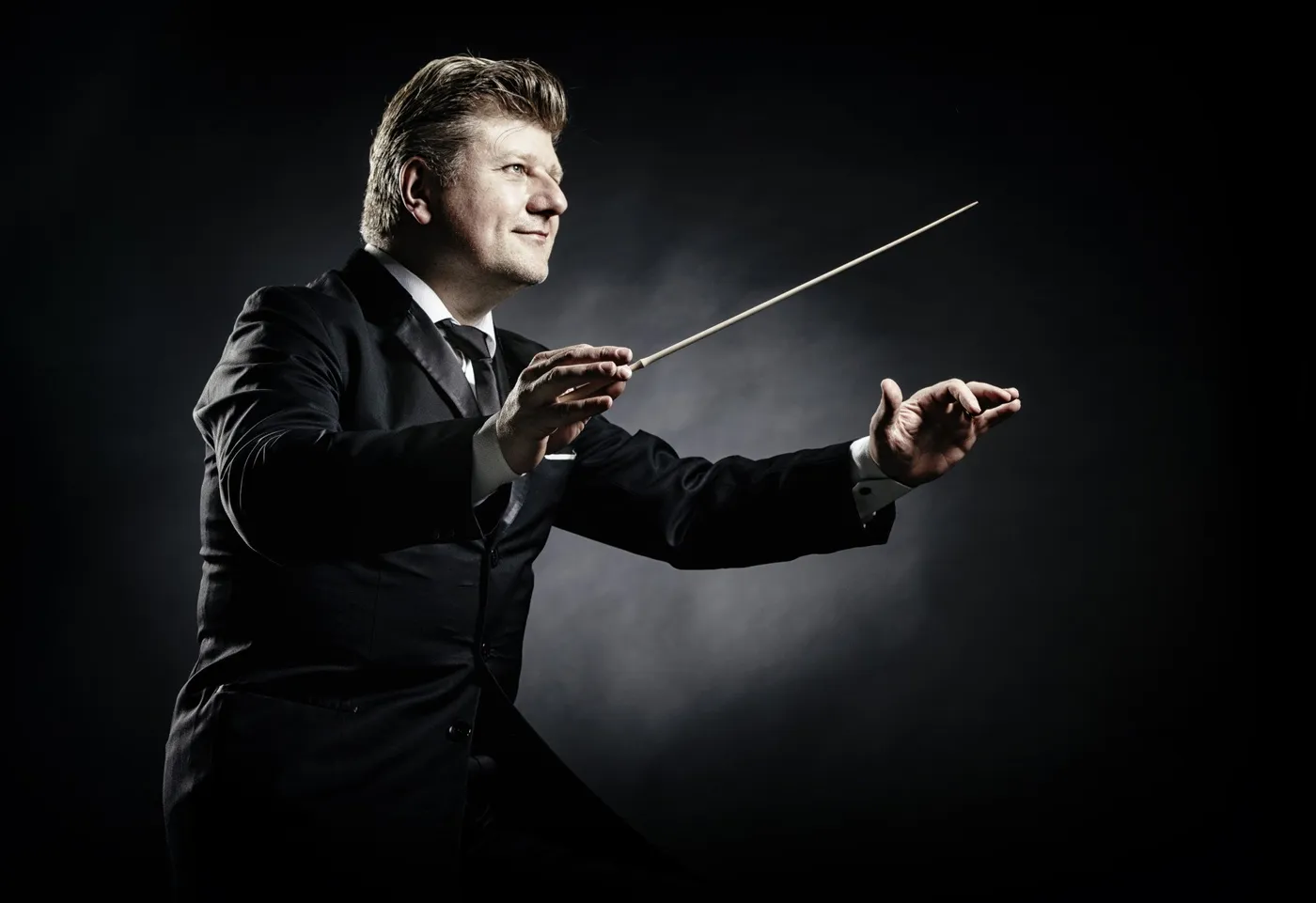
THE FOREST HORN AND DANCES OF CENTRAL EUROPE
Košice State Philharmonic
Radek BABORÁK, conductor and French horn
Program:
Wolfgang Amadeus Mozart: Three German Dances, K. 605 8'
Reinhold Glière: Concerto for French Horn and Orchestra in B-flat major, Op. 91 28'
— intermission —
Ľudovít Rajter: Symphonic Suite 12'
Béla Bartók: Romanian Folk Dances, Sz. 68, BB 76 7'
Zoltán Kodály: Dances of Galanta 16'
The Concerto for French Horn and Orchestra in B-flat major, Op. 91, is one of the best-known works by the Russian composer Reinhold Glière. Glière composed it in 1951, at a time when he already had extensive experience with symphonic, operatic, and ballet compositions. The first movement is based on a traditional sonata form, which Glière, however, enriches with sweeping melodies and contrasting episodes. The second movement is characterized by lyrical expression, while the finale is built on rhythmic vitality, virtuosic agility, and brilliant interplay between the soloist and the orchestra, culminating in a spectacular conclusion.
The symphonic suite was composed between 1932–1933 and belongs to the early orchestral works of Ľudovít Rajter, which still significantly reflect the musical environment of his studies with Ernő Dohnányi at the Liszt Academy in Budapest. In Rajter’s early compositions, one can observe the interplay of the late-Romantic tradition with influences from Hungarian musical culture. Folk elements serve as a source of rhythmic energy and melodic distinctiveness, while the work is characterized by formal compactness and a distinctive, inventive appeal. At the same time, Rajter demonstrates a sense of orchestral color, rhythmic vitality, and melodiousness, as well as the ability to transform elements of the Central European musical tradition into a distinctive symphonic language.
The Romanian Dances are among Béla Bartók’s most popular works. Originally, it was a piano suite consisting of six short pieces, which Bartók composed in 1915. Its orchestral version was created two years later. At the heart of this cycle are authentic Romanian melodies that the composer recorded in villages in Transylvania, preserving their original melody and rhythmic structure. He pushed the tempo to the limits of expression; in his interpretation, the fast dances become a literally sweeping whirlwind of music, while he allowed the slow melodies to shine in a free and meandering tempo.
Elements of Hungarian folk music have always been the focal point of Hungarian composer Zoltán Kodály’s work. His Dances from Galanta are basedon the folk music of the Galanta region, where Kodály lived for several years. The work is structured in two parts: — a slow introduction and a series of four fast dances with typical, captivating dance rhythms reminiscent of the genre of regrút songs that inspired Kodály. The introduction consists of a three-part slow section with an orchestral opening, a cadenza, and a subsequent majestic section marked Andante maestoso, followed by a fast section featuring a sequence of dynamic and brilliant dances in typically syncopated rhythms.