
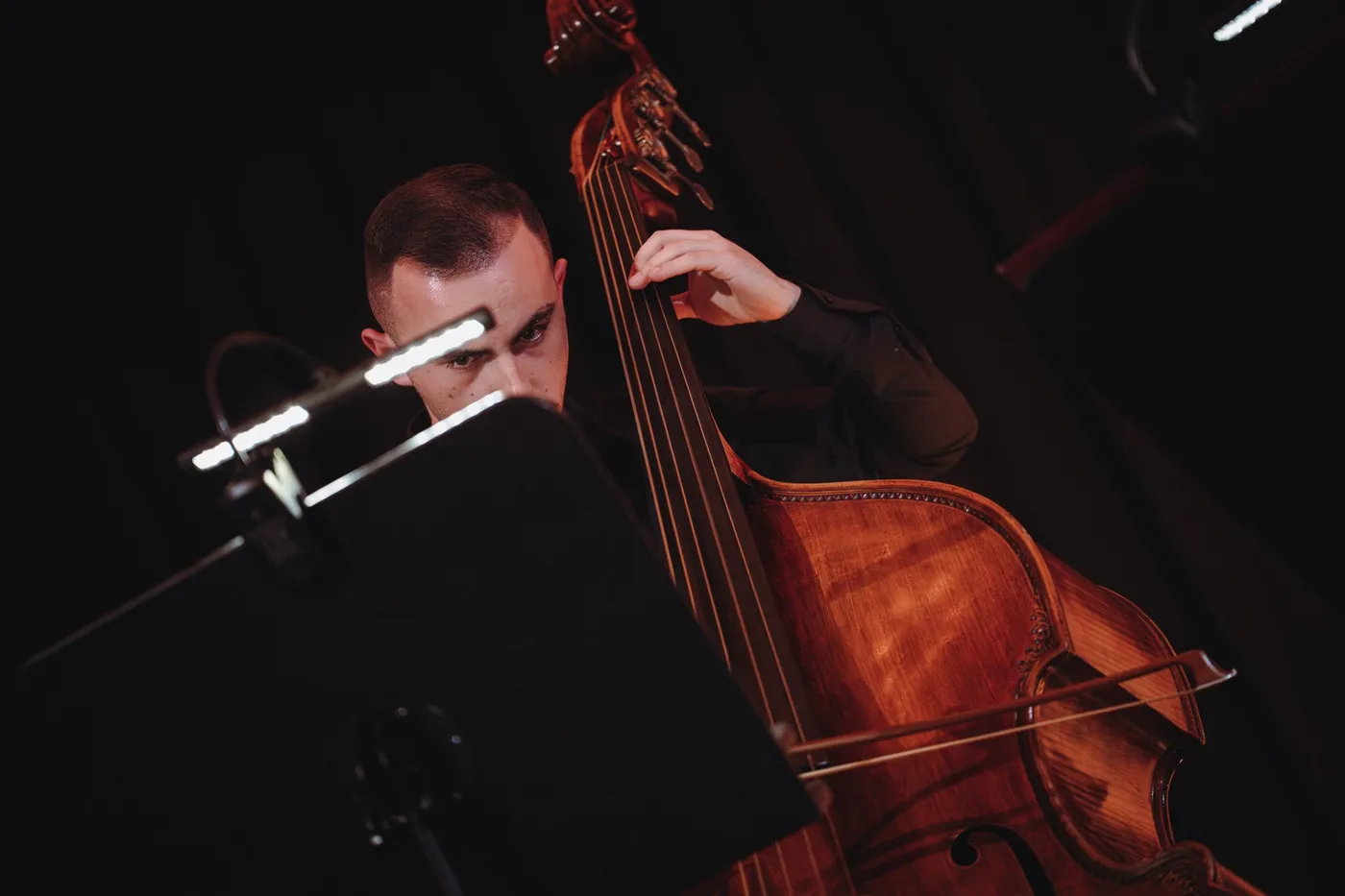
WE PLAY CHAMBER MUSIC I
Peter ZWIEBEL, viola
Peter KATINA, accordion
Bohdan SHUST, Adolf PLACHETKA, Vladimír ČEKAN, Boris PASTERÁK, double basses
Program:
Arvo Pärt: Fratres 11'
Martin Lohse: Concerto for Viola and Accordion – Slovak premiere 6´
Lewis Murphy: Breathing Space – Slovak premiere 7´
Yevgeny Irshai: Commissioned work for viola and accordion – premiere 7'
Colin Brumby: Suite for Four Double Basses 1 2'
Franz Schubert: The Spirit King, D 328 (arrangement for four double basses: D. Sundy) 4'
Detlev Glanert: Four Quartets, Op. 12 13'
The piece *Fratres* was written by the Estonian composer Arvo Pärt (1935) in 1977 and is among his most frequently performed works. It is written without a fixed instrumentation and can be performed on various instruments. Structurally, the piece consists of a series of variations separated by recurring percussive motifs. The music consists of two melodic lines that move predominantly in stepwise motion, and a central voice, known as the “tintinnabuli,” which moves within a modal triad. The apparent simplicity of the composition is governed by strict mathematical rules that determine the movement of the voices, the length of the melodies and phrases, and the alternation of time signatures.
Danish composer Martin Lohse (1971) studied composition and music theory at the Royal Danish Academy of Music in Copenhagen under Hans Abrahamsen and Niels Rosing-Schow. As the title of his work suggests, it is a miniature concerto in three movements: Allegro – Andante – Allegro, inspired by Baroque music—particularly the works of Antonio Vivaldi—and featuring several unexpected twists, especially toward the end of the piece.
Lewis Murphy (1982) is one of the leading figures among the younger generation of Scottish composers. He studied at the Royal Conservatoire of Scotland and later at the Royal College of Music in London under Mark-Anthony Turnage. He wrote the following about his 2019 composition *Breathing Space*: “This work is inspired by the theme of home. For me, home is a place of relaxation, where one can slow down and escape the stress of the world, where it is possible to simply let everything breathe. The music here creates an organic texture that is occasionally interrupted by short ‘breaths.’
Yevgeny Irshai (1951) was born in Leningrad. He has lived and worked in Slovakia since 1991. He currently teaches at the Academy of Performing Arts (VŠMU) in Bratislava. Iršai devotes considerable attention to works for solo accordion, as well as to pieces combining the accordion with string instruments. His compositional portfolio includes nearly twenty works for this instrument, spanning solo, chamber, and orchestral music. The premiere of his new work “…Know Not Whither…Know Not What…” for viola and accordion also marks a significant milestone in his life this year.
In the composition *Suite for Four Double Basses*, the deepest-sounding orchestral instruments become a full-fledged chamber ensemble. Australian composer, educator, and conductor Colin Brumby composed this suite in 1975. Brumby treats the double basses as four equal voices that can create a dense texture but also perform as independent melodic or rhythmic lines. The composer makes use of contrasts in register, dynamics, and rhythmic movement, transforming the instruments into an exceptionally flexible chamber ensemble. The suite consists of four movements, each with distinct tempo and expressive characteristics. The opening movement is marked Allegro, followed by a slow Larghetto. The third movement brings a livelier pace once again, and the final movement returns to a slower tempo. The alternation of fast and slow sections creates a varied dramatic arc for the work and showcases the double bass across a wide range of its expressive possibilities.
In Daniel Sundy’s arrangement of Schubert’s song “Erlkönig” for four double basses, the original contrast between voice and piano is transformed into a dialogue among four equal instruments. At the same time, the deep register of the double basses radically alters the timbre of Schubert’s music, and the musical text—which in the original version was based on the combination of the human voice and pianistic virtuosity—takes on a darker, more intimate, and at times even ominous character.
The Four Quartets, Op. 12, by the German composer Detlev Glanert are among his early chamber works. The composition was written between 1984 and 1986 and is scored for the unusual ensemble of four double basses. Glanert divided the work into four contrasting movements titled “Ballade,” “Walzer,” “Chanson,” and “Romanze.” In it, he plays with forms and genre associations from the European musical tradition. Here, the double basses lose their usual role as the cornerstone of the orchestral sound and become four equal chamber voices. The varied layering of the parts gives rise to a remarkable, polyphonically structured texture in the music.