
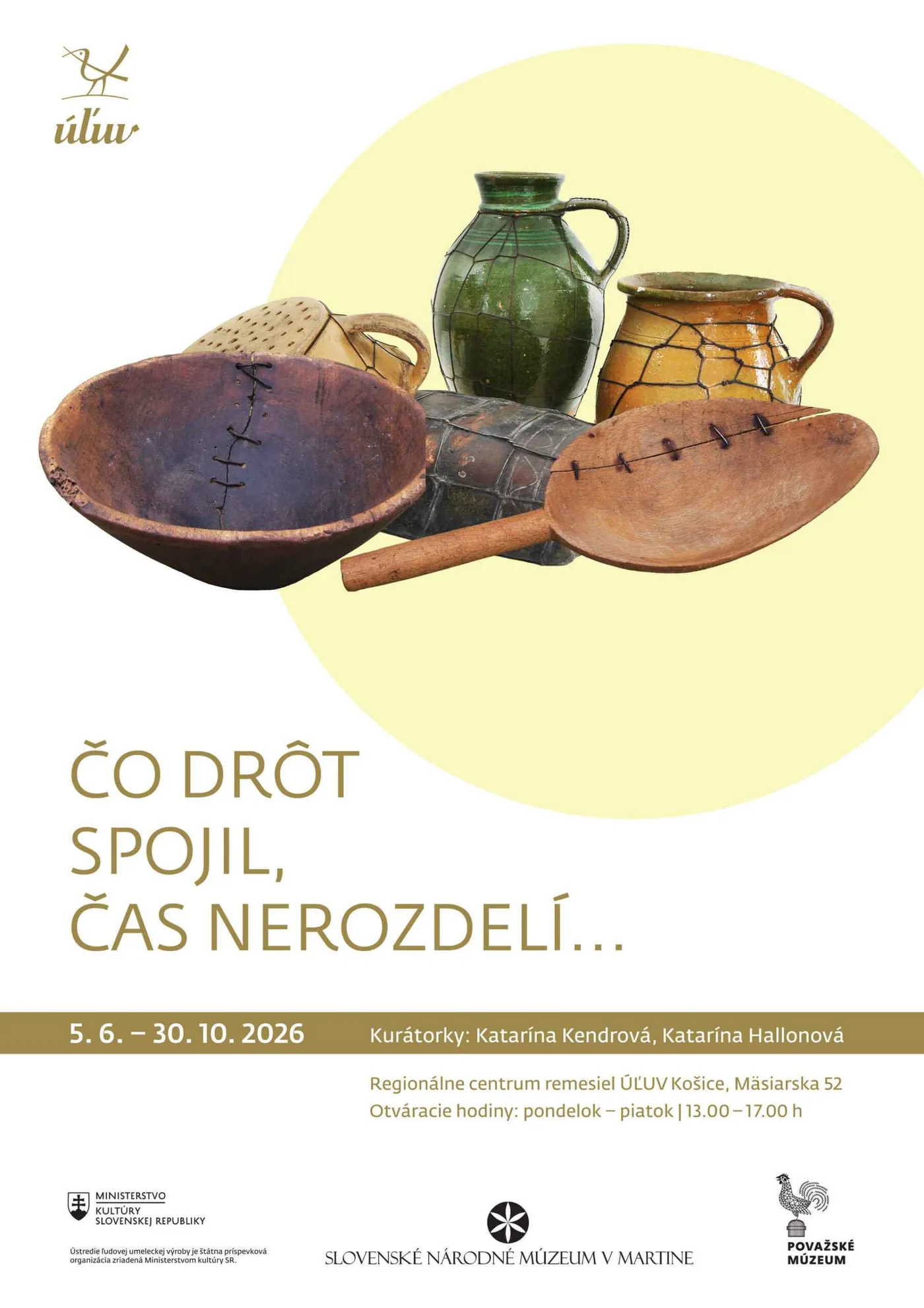
What the wire has joined together, time will not separate...
Wire is the central material theme of ÚĽUV in 2026. The exhibition in the ÚĽUV Gallery in Mäsiarská 52, Košice, is dedicated to tinkering in its original vagabond form, when tinkers wandered around the countryside and were mainly engaged in repairing objects of everyday use for the rural population. Its authors are ethnologist Katarína Kendrová and historian Katarína Hallonová from the Považský Museum in Žilina, who have long specialised in research and documentation of this craft, which has been included in the UNESCO Representative List of the Intangible Cultural Heritage of Humanity since 2019. Step into the past with us and discover the beauty of tinkering at the ÚĽUV Košice Regional Crafts Centre from 5 June to 30 October 2026.
What the wire has joined together, time will not separate...
Location.
Open: Monday - Friday | 13.00 - 17.00 h
Duration: 5 June - 30 October 2026
Katarína Kendrová, Katarína Hallonová
The constant struggle for a secure rural existence required a wide range of diverse tools, utensils and instruments that quickly wore out, but people often did not have enough money to buy new ones. And it was thanks to tinkers that damaged items were given a chance to be used again. There was probably not a tool in the household that they did not try to restore, or their work inspired the householders themselves to make repairs themselves.
The exhibition brings together the basic areas of human life in the past, which were connected with food preparation and dining, work in the fields and on the farm, and the processing of the textile fibres necessary for the production of clothing. Visitors can thus see in one place more than two hundred exhibits of the most varied functions, shapes and materials (clay, wood, wicker, horn, sheet metal, glass, porcelain, stoneware, etc.), all of which are repaired with wire or sheet metal.
Ceramic ware, which was the primary and largest focus of repair by the tinkers, is predominant. There is also a rich representation of restored tin and wooden vessels, kitchen and shepherd's tools (pots, strainers, coffee roasters, tomatoes, kettles and cauldrons, kettles, galleys, troughs and troughs, butter churns, shepherd's vats, cheese and gingerbread moulds, salt cellars and pumpernickel pans). Interesting tinkering repairs can also be seen by those interested in the subject on agricultural implements, for example on shovels, forks, scythes and scythes, rakes, donkeys, baskets and sickles. Wheelbarrows, horseshoes, pickaxes, heating irons and many other ancient objects have not escaped the intervention of tinkers. Rare exhibits also include precision and finely braided glass, porcelain and sea foam pipes.
The exhibition is enriched by expert texts with photographs and also detailed descriptions of specific tinkering repair techniques, whether basic, which included braiding into wire nets, flecking, embroidery, soldering, or simpler, which consisted in pulling off damaged parts of objects with a wire loop or strip of sheet metal, or other, more complex ones.
All presented exhibits come from the collections of the Považský Museum and the Slovak National Museum in Martin.
We look forward to your visit!